
THE TOOLS I RELY ON
The cameras, lenses and equipment I rely on to photograph and film fast-moving events, people and places. My kit is built around speed, reliability and flexibility, allowing me to move seamlessly between photography, video and aerial storytelling.
Cameras
My primary camera and the backbone of my professional work. Its speed, autofocus and durability make it ideal for demanding event days, fast-moving motorsport and situations where there is only one chance to capture the moment.
Nikon Z9
My compact filmmaking camera for interviews, documentary work and more considered video production. It gives me a lighter, more flexible setup while maintaining the image quality and familiar Nikon system I rely on.
Nikon ZR
My compact aerial camera for establishing shots, landscapes and showing the wider environment around a story. It allows me to add scale, movement and a stronger sense of place without carrying a large drone system.
DJI Mavic Mini 5
Used whenever I need to place a camera somewhere a larger setup would be impractical. It is particularly useful for immersive angles, in-car footage, behind-the-scenes moments and perspectives close to the action.
DJI Action 6
Lenses
Nikkor Z 24-70mm f/2.8 S
The lens that spends the most time on my camera. It covers everything from wider environmental photographs to portraits and detailed moments, making it my main choice for fast-paced event coverage.
Nikkor Z 70-200mm f/2.8 VR S
Essential for motorsport, stage work and capturing natural moments from a distance. The longer focal length helps isolate subjects, compress backgrounds and photograph the action without interrupting it.
Nikkor Z 35mm f/1.4
My preferred lens for documentary-style storytelling, low-light environments and photographs that place people within their surroundings. It creates an intimate perspective without feeling overly wide or intrusive.
Nikkor Z 28mm f/2.8
A small, lightweight lens for travel, everyday photography and occasions when I want to keep the camera setup minimal. Its wider perspective is useful for spontaneous moments and photographs with a strong sense of environment.
Laowa 10mm f/2.8 FF Zero-D
An ultra-wide lens used for architecture, interiors, dramatic establishing shots and unusual perspectives. It allows me to capture the scale of a location when even a conventional wide-angle lens is not wide enough.
Equipment
My wireless audio system for interviews, presenter-led videos and documentary content. Clear audio is just as important as the image, and this gives me a reliable way to capture voices while remaining mobile.
DJI Mic 3
My portable lighting solution for event photography, quick portraits and difficult lighting conditions. It gives me consistent, controlled light while remaining compact enough to use throughout a busy working day.
Profoto A10
My main stabilisation tool for smooth, controlled camera movement. I use it for tracking shots, venue walkthroughs, automotive sequences and more cinematic moments where handheld movement would be too distracting.
DJI RS5 Gimbal
About
Tristan
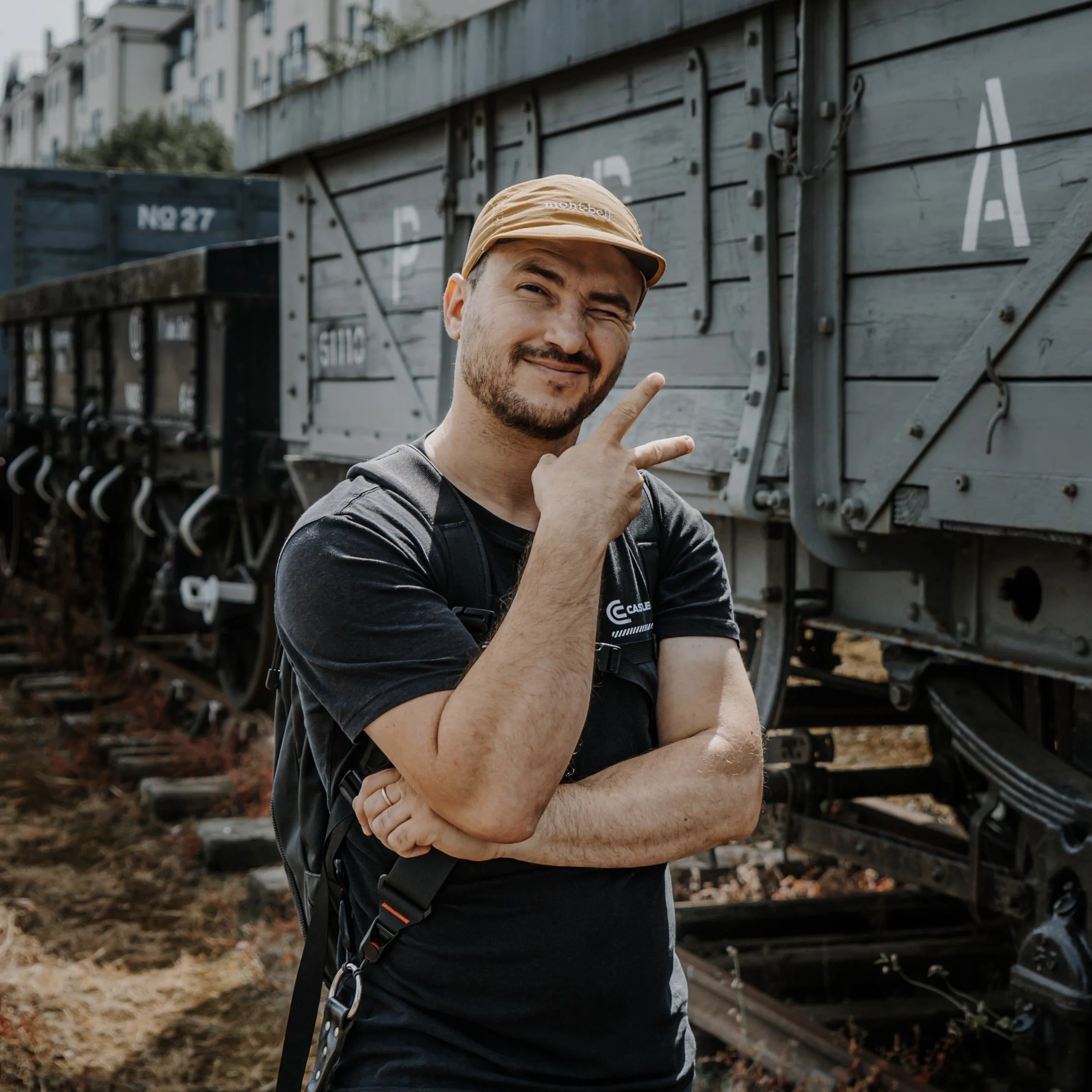
“We are surrounded by more photographs than at any point in history, but we trust them less than ever.”
COVID changed something. Whatever you believe happened during that period, most people came out of it questioning who and what they could trust: governments, companies, the media, social platforms, other people, perhaps even their own understanding of the world.
People became better at recognising when something was being sold to them.
That is partly why user-generated content has become so powerful. It is rarely the most technically impressive content, but it often feels the most believable. It looks like something a real person experienced and chose to share, rather than something an organisation manufactured to persuade us.
Almost every brand, event and destination now faces the same problem:
How do you show people something without making it feel like another advert?
That question sits at the centre of my work.
When I first started photographing festivals, most photographers focused on the artists and enormous crowd shots. The images could be spectacular, but they always confused me slightly.
The person considering buying a ticket would never experience the festival from the photographer’s pit.
They would experience the anticipation, the mud, the ridiculous outfits, the strangers becoming friends and the moment someone forgot anyone else was watching and completely lost themselves in the music.
That was the festival.
I noticed the same thing in motorsport. There were endless photographs of cars travelling around circuits, usually taken from places the average visitor could never access.
But people do not spend their weekends at racetracks simply because cars move quickly. They go for the noise, the machinery, the early mornings, the paddock conversations and the feeling of being surrounded by people who care about the same strange thing they do.
A photograph can show what happened without explaining why it mattered.
I have always been more interested in what it feels like to be there as a person than what it looks like to be there as a photographer.
Perhaps that comes from never feeling entirely normal myself.
I grew up in France and moved into the English school system at ten, barely speaking English. For years, I felt as though everyone else had been given instructions for how to behave and I had somehow missed them.
It took me a long time to feel comfortable in the world, but being slightly outside something teaches you to observe it.
My brain naturally looks for the larger pattern. I notice contradictions, relationships and small moments that seem unimportant until they are placed inside the wider story.
Everyone sees them. Not everyone recognises why they matter.
Photography became my way of making sense of those things.
I think of lifestyle photography as something close to street photography: real people, real environments and genuine reactions, sometimes with just enough direction to allow something to happen.
That does not mean manufacturing fake happiness. People recognise that immediately.
It means creating the conditions for something real to emerge.
After more than fourteen years and well over a million photographs, I do not think photography itself is really the point.
I am interested in people, places and the stories we use to understand the world. Cameras simply allow me to explore them, preserve what I find and share my perspective with somebody who was not there.
My job is not to manipulate people into believing something that is not true.
It is to find what is true, understand why it matters and translate it into something another person can feel.
That is how I see it.
But I am far more interested in starting conversations than pretending I have all the answers, so tell me: what makes something feel real to you? - tristan@caltristan.com
FAQ
-
I create people-focused photography for brands, events, festivals, destinations, organisations, and lifestyle projects.
My work focuses on capturing authentic moments, atmosphere, storytelling, and human connection rather than simply documenting what happened.
-
I work with brands, event organisers, tourism businesses, festivals, venues, organisations, and individuals looking for professional visual content.
Whether you’re promoting an event, showcasing a destination, building a brand, or telling a story, I tailor coverage to your goals and audience.I work with brands, event organisers, tourism businesses, festivals, venues, organisations, and individuals looking for professional visual content.
Whether you’re promoting an event, showcasing a destination, building a brand, or telling a story, I tailor coverage to your goals and audience.
-
Every project is different, but may include:
• Photography coverage
• Behind-the-scenes storytelling
• Brand and marketing imagery
• Social media content
• Event and atmosphere coverage
• Portraits and environmental portraits
• Optional short-form video contentDeliverables are always tailored to the needs of each client.
-
Yes.
Alongside photography, I offer short-form video content designed for websites, social media, and promotional use.
Video can be included as part of a wider content package where appropriate.
-
I’m comfortable working independently or alongside existing marketing, media, and communications teams.
I can follow established brand guidelines while creating content that integrates seamlessly with existing campaigns and workflows.
-
Turnaround depends on the size and complexity of the project.
Where required, priority images and social content can often be delivered during or shortly after an event, with final galleries delivered on an agreed schedule.
-
Licensing is discussed as part of each project.
Most commissions include usage across websites, social media, digital marketing, and promotional channels.
Extended licensing can be arranged where required.
-
Yes.
I’m available throughout the UK and internationally, and have experience working across a wide range of events, locations, and environments.
I speak fluently both in English and French.
-
The best place to start is a complimentary discovery call.
We’ll discuss your project, goals, audience, and deliverables before deciding whether we’re a good fit to work together.
-
Yes.
I work on one-off projects, recurring content creation, seasonal campaigns, and long-term partnerships where ongoing visual storytelling is required.